Newbox NEWBOX Protect · Present · Perform
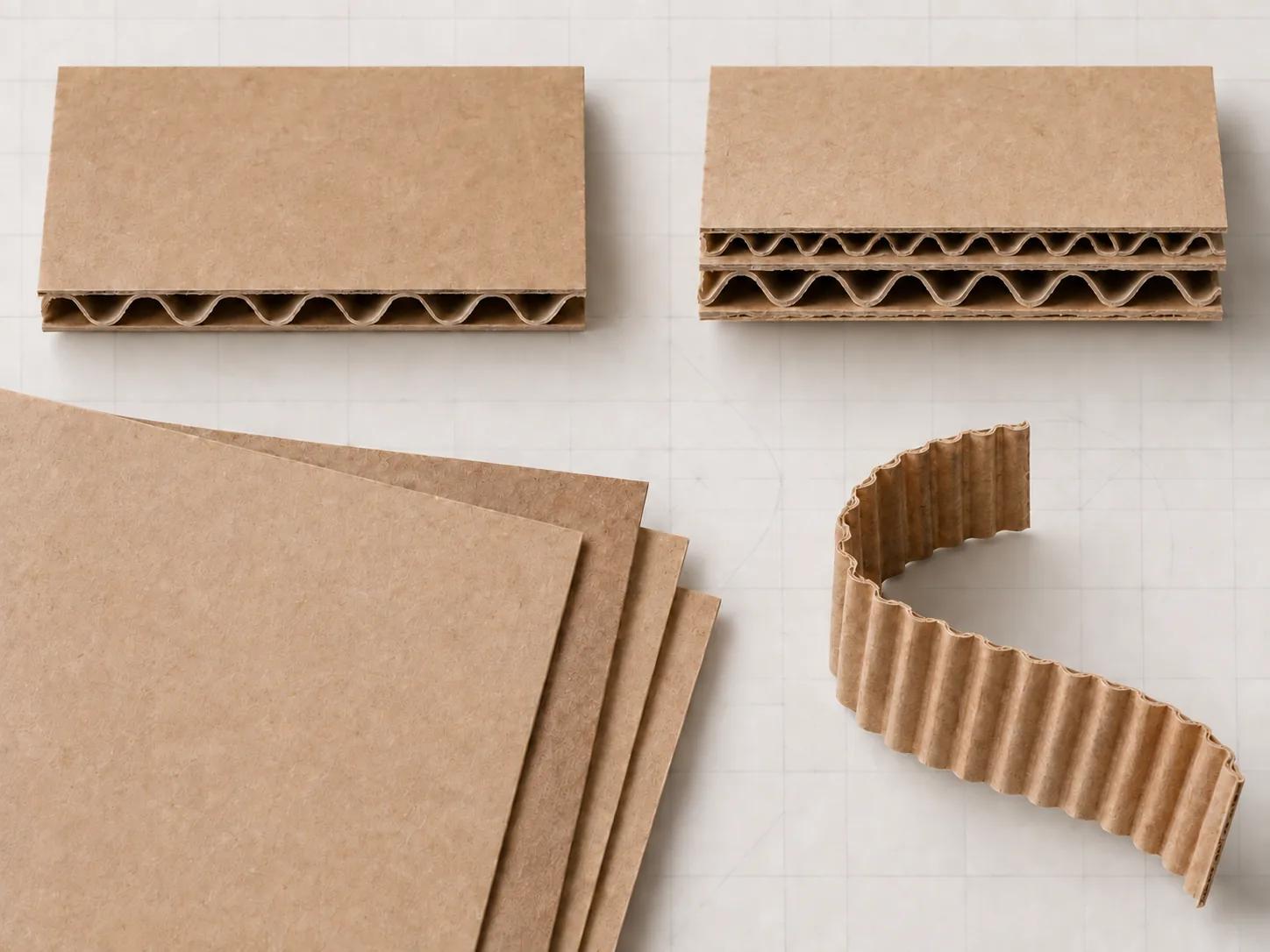
Single-wall board, BA double-wall board, kraft liner sheets and corrugating medium arranged on a studio worktable
BUYER GUIDE · CORRUGATED BOARDUNDERSTAND BEFORE YOU SPECIFY

Corrugated board basics

WHAT IS INSIDE
THE BOARD?

Decode paper grades, compare flutes and box styles, and measure your carton correctly. Practical answers to help you specify a better pack.

SINGLE WALL · DOUBLE WALL · KRAFT · RECYCLEDBOARD GUIDE

01 / Inside the board

Three layers.
Each with a purpose.

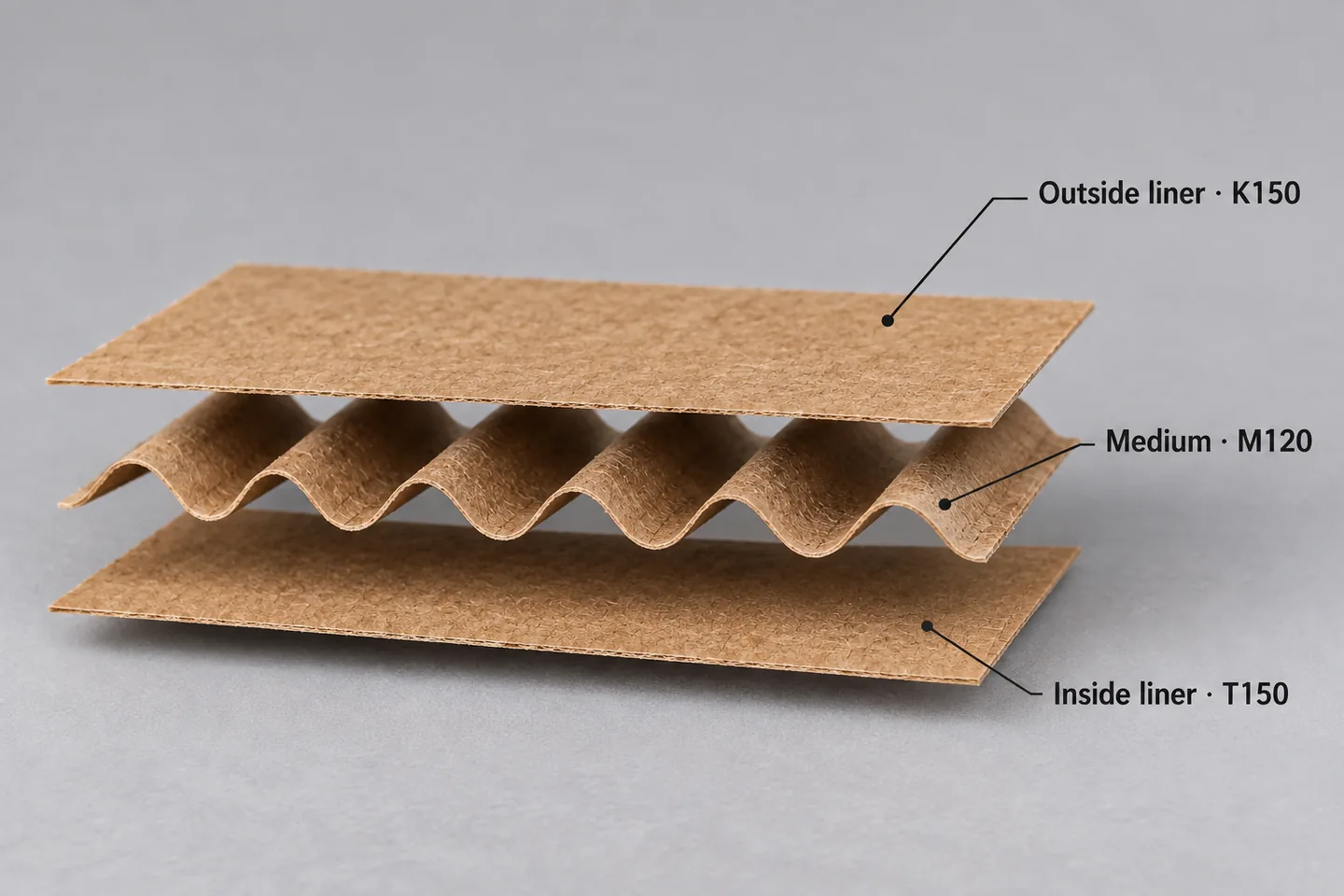
Single-wall board brings two flat liners and one fluted medium together. Here is how K150 / M120 / T150 describes those individual papers.

Exploded single-wall board: top flat outside liner K150, middle wavy medium M120, and bottom flat inside liner T150, on a grey studio background
Example shown outside to inside. The letters describe the paper; the numbers give its weight in gsm. Tap the image to see the details.
01 / OUTSIDE LINER

K150

Kraft liner · 150 gsm
The outer paper surface.

02 / MEDIUM

M120

Corrugating medium · 120 gsm
The wave between the liners.

03 / INSIDE LINER

T150

Test liner · 150 gsm
The inner paper surface.

Illustrative paper combination. Confirm the layer order and flute when specifying a carton; a paper code alone is not a tested load capacity.

02 / Wall construction

Count the liners and fluted layers.

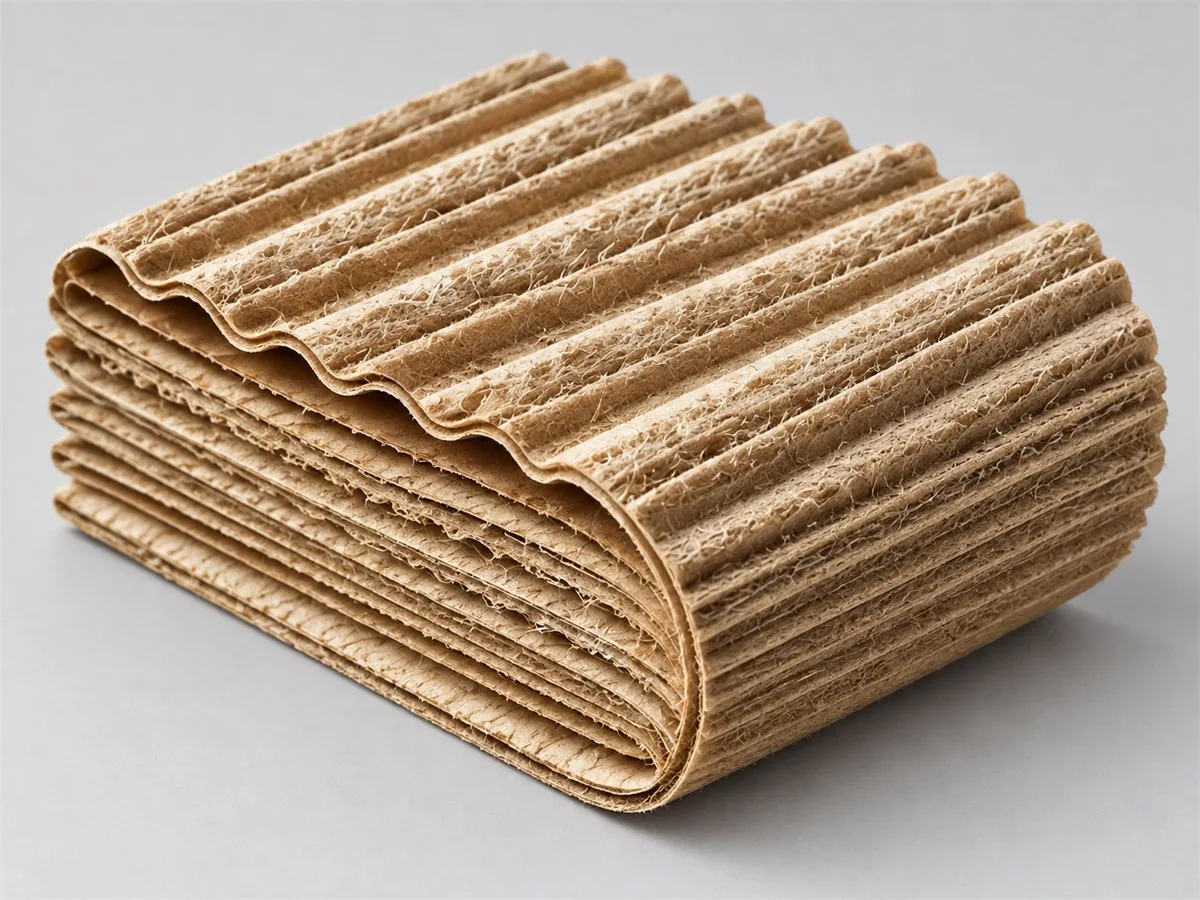
The fluted paper creates air columns between liners. Those columns help the finished board resist crushing and absorb handling impact.

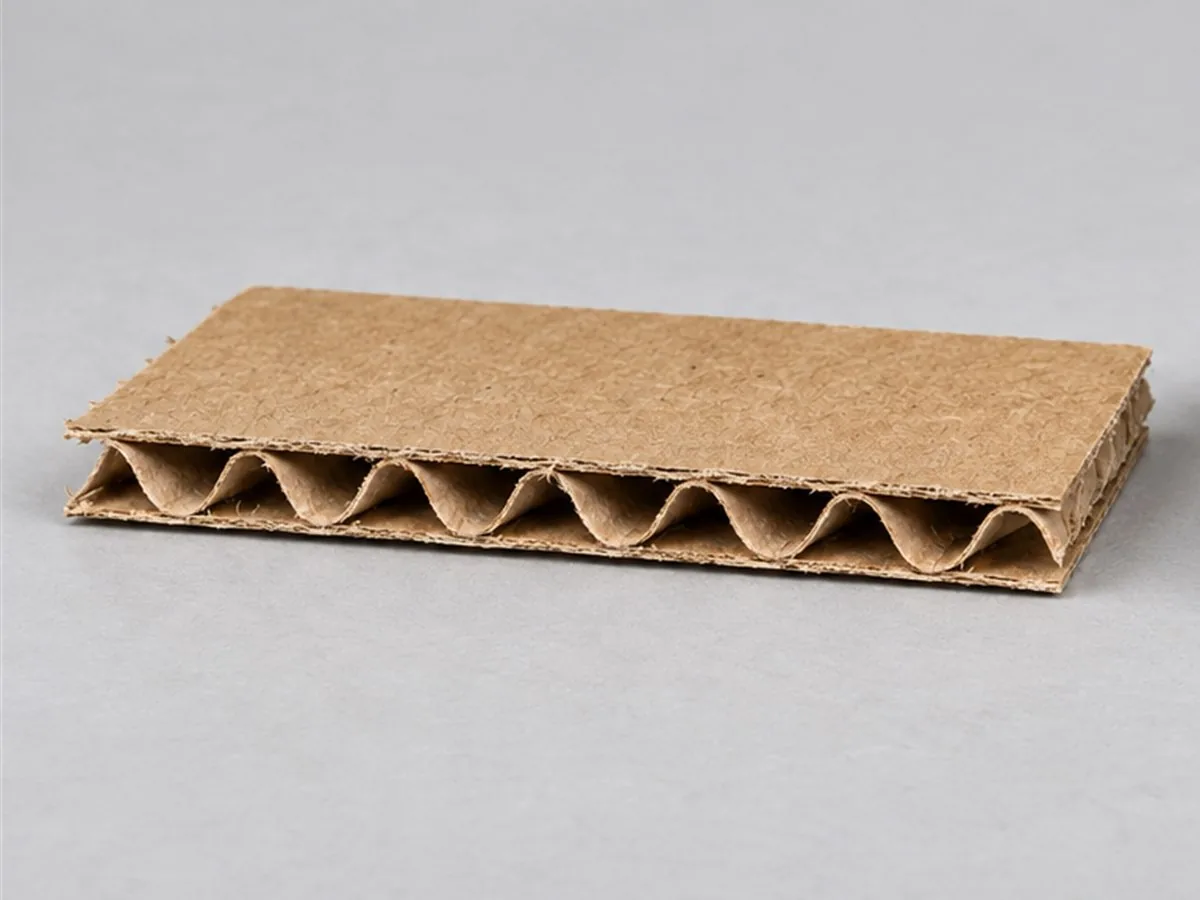
Close-up of real single-wall corrugated board

2 liners / 1 medium

Single wall board

A practical choice for many shipping, storage and retail cartons when the product weight and stacking load are moderate.

  • Lower material use and pack weight
  • A, B and E are commonly used; C is less commonly selected
  • Suitable for many everyday cartons
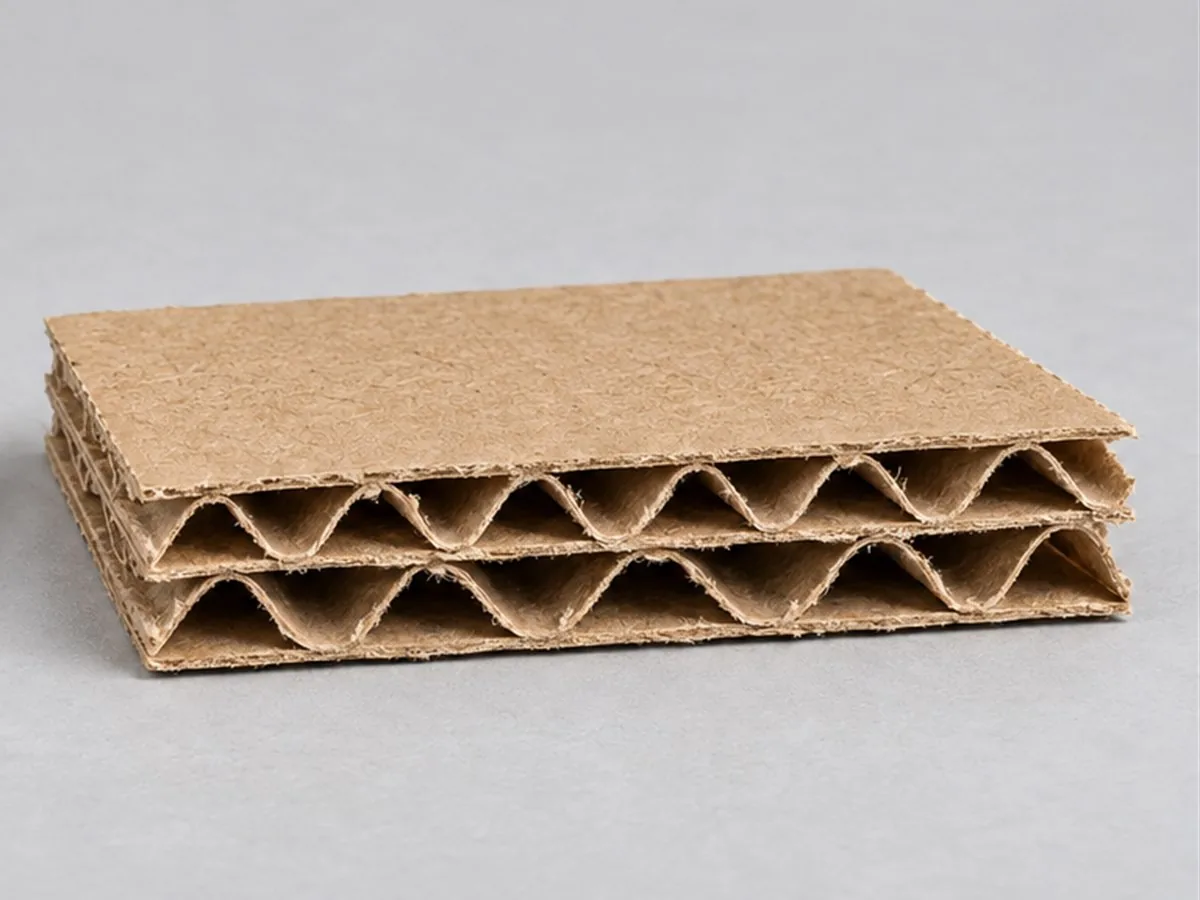
Close-up of real double-wall corrugated board

3 liners / 2 mediums

Double wall board

Additional layers provide greater rigidity, puncture resistance and stacking support for more demanding distribution conditions.

  • Better support for heavier products
  • Common BA or BE combinations
  • Useful for stacking and rougher handling
What about triple wall?

Triple wall uses four liners and three fluted mediums. It is reserved for very heavy-duty requirements; BAB and ABA reference profiles are included in the flute table below.

03 / Paper selection

Kraft liner, recycled liner and medium.

The outside colour alone does not prove paper type or strength. Compare the material, then choose the grade and board combination for the product journey.

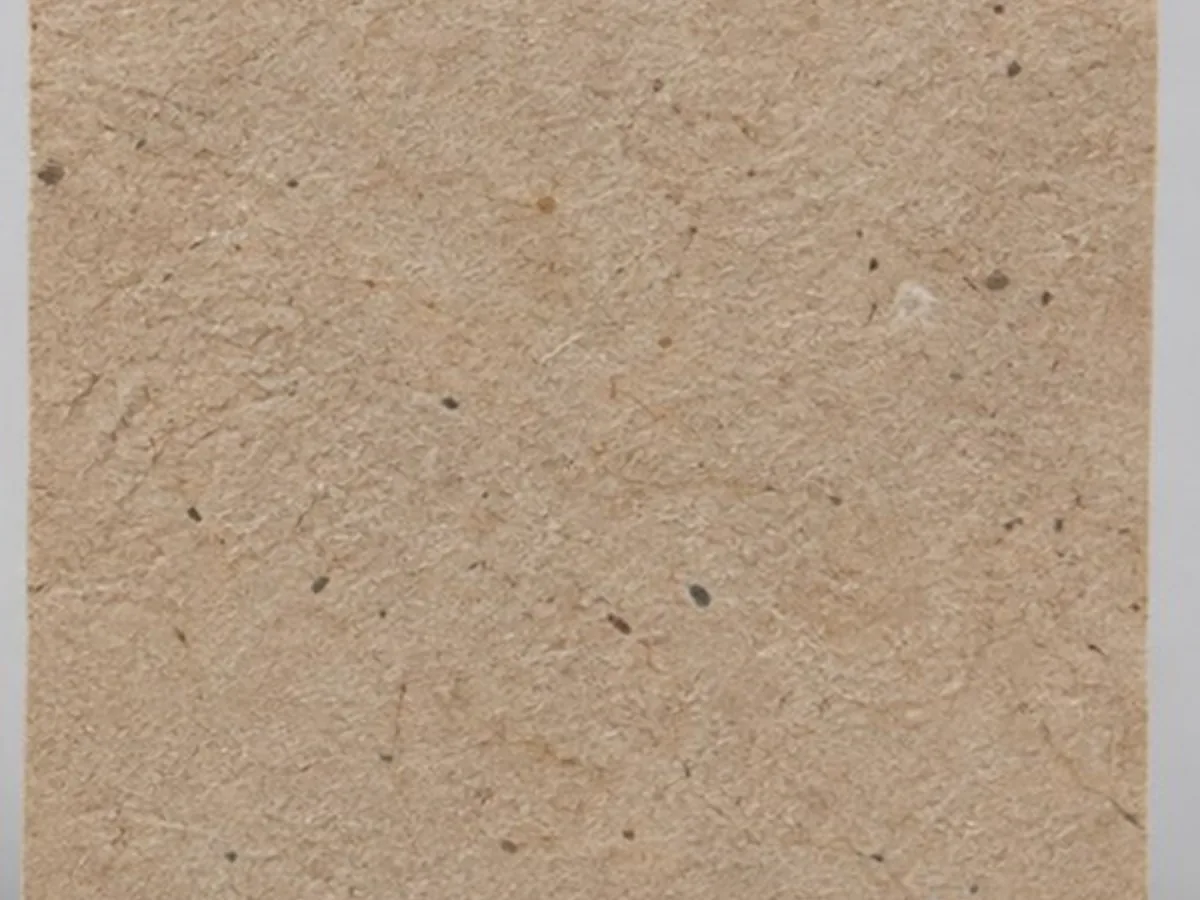
Close-up of dark kraft liner paper fibres

K / kraft liner

Kraft liner

Kertas pelapik kraft

Nature
High strength and durability
Content
Mainly virgin kraft fibre
Colour
Usually darker, cleaner brown
Why choose it
  • Export or longer delivery routes with more handling and stacking
  • Chilled or refrigerated packs when suitable moisture-resistant treatment and testing are specified
  • Natural kraft branding and a cleaner, more consistent outer surface

Standard kraft paper is not waterproof.

Close-up of lighter recycled test liner paper fibres

T / test liner

Recycled liner

Kertas pelapik kitar semula

Nature
Strength depends on the selected grade
Content
Recovered paper fibre
Colour
Often lighter or more varied
Why choose it
  • General domestic shipping and shorter distribution journeys
  • Light or moderate loads when the selected grade meets stacking requirements
  • Recycled-content goals and cost-efficient board combinations

Recycled liner can still be specified for shipping cartons when the complete board is suitable.

Real exposed corrugating medium showing recycled paper fibres

M / corrugating medium

Corrugating medium

Kertas beralun

Nature
Formed into flutes to provide structural support
Content
Often recycled fibre; composition varies by grade
Colour
Usually greyish or muted brown
Why it is used
  • Forms the internal wave between liners
  • Adds cushioning, separation and board rigidity
  • Works with the selected flute profile and liner grades

Medium is an internal structural paper, not an outer-liner substitute.

Important

A brown carton may use kraft liner, recycled liner or a combination of both. Confirm the specification instead of judging by colour.

150 gsm vs 175 gsm

What does GSM tell you?

GSM means grams per square metre of paper. A 175 gsm paper has more mass per unit area than a 150 gsm paper, but this is not a guaranteed increase in carton strength.

Read the complete specification

Paper + flute + carton.

Ask which layer the GSM refers to. Compare the paper grade, flute profile and full board combination, then confirm the carton size and performance required.

Full paper-grade referenceGSM and pound equivalents for technical buyers

These are Newbox reference grades. Final availability and the suitable paper combination are confirmed for each order.

PaperSymbolGSMPound
Kraft linerK280 / 27564 lb
Kraft linerK180 / 17542 lb
Kraft linerK15033 lb
Test linerT280 / 27564 lb
Test linerT180 / 17542 lb
Test linerT15033 lb
Test linerT12526 lb
Corrugating mediumM180 / 17542 lb
Corrugating mediumM15033 lb
Corrugating mediumM12026 lb
Corrugating mediumM10023 lb
White linerW180 / 17542 lb
Conductive linerC180 / 175 or 15042 or 33 lb

04 / Flutes & thickness

See the flute.
Compare the thickness.

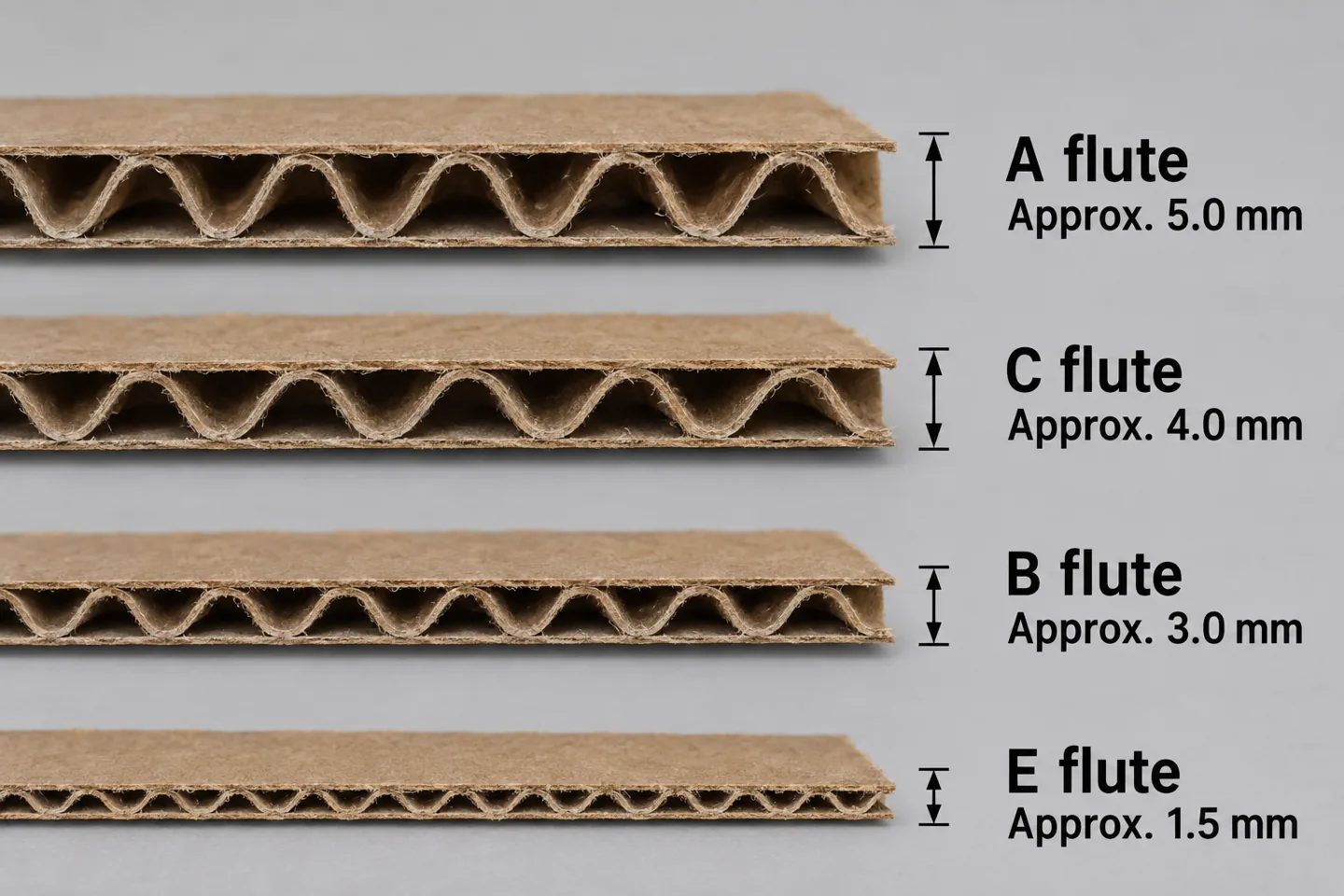
The wave changes the board’s profile. A flute is deeper; B flute is more compact. C and E provide other thickness options for different packaging needs.

Grey-studio reference showing A flute approximately 5.0 mm, C flute 4.0 mm, B flute 3.0 mm and E flute 1.5 mm
Approximate finished-board thickness: A 5.0 mm · C 4.0 mm · B 3.0 mm · E 1.5 mm. Illustrative profiles, not a measuring scale.

B flute / approx. 3.0 mm

A compact profile.

Smaller, closer flutes offer a relatively smooth printing surface and a slimmer pack. Commonly considered for general cartons.

A flute / approx. 5.0 mm

More cushioning depth.

Taller flutes add thickness and cushioning. Choose the liners and internal protection to suit the product and its journey.

Neither thickness nor flute letter alone guarantees a stronger carton. Paper grade, construction and finished-carton performance also matter.

Full flute & wall referenceSingle, double and triple wall · nominal thicknesses
ConstructionFluteApprox. thicknessCommon reason to consider it
Single wallA5.0 mmThicker cushioning and vertical compression support
Single wallB3.0 mmGood rigidity with a compact profile
Single wallE1.5 mmFine flute for compact packs and better presentation
Single wallC4.0 mmLess commonly selected; balanced cushioning and stacking when specified
Double wallBA8.0 mmHeavy-duty stacking, cushioning and protection
Double wallBE4.5 mmStrength with a slimmer profile and smoother surface
Triple wallBAB11.0 mmVery heavy-duty protection and stacking support
Triple wallABA13.0 mmMaximum reference thickness for demanding loads

Why approximate? Finished thickness can vary slightly with paper grade, moisture, corrugating pressure, adhesive and normal production tolerance between runs or suppliers. Values shown are Newbox's nominal material reference.

05 / Carton styles

Different ways
to pack and close.

RSC, HSC and 5PF describe the carton’s construction. Choose the style separately from the paper grade and flute.

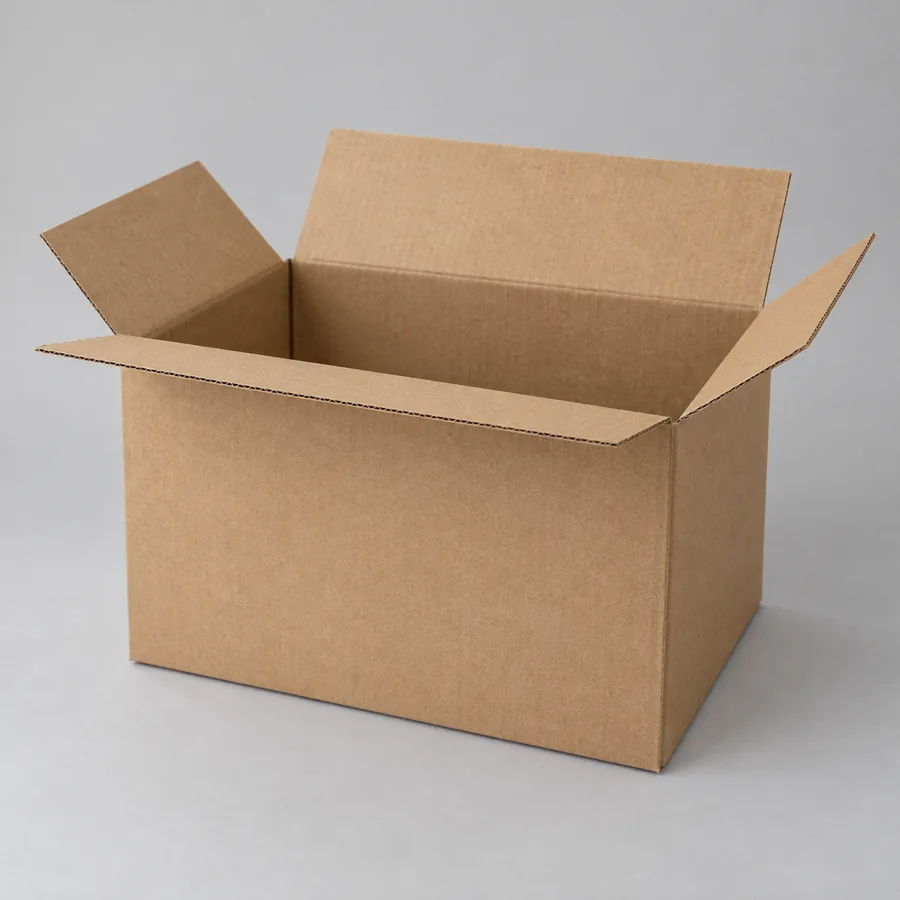
Realistic reference of a regular slotted carton with four open top flaps on a grey studio background

RSC

Regular slotted carton

Top and bottom flaps close the carton. The outer flaps meet at the centre.

Common use
Everyday shipping and storage.

Look for: top and bottom flaps.

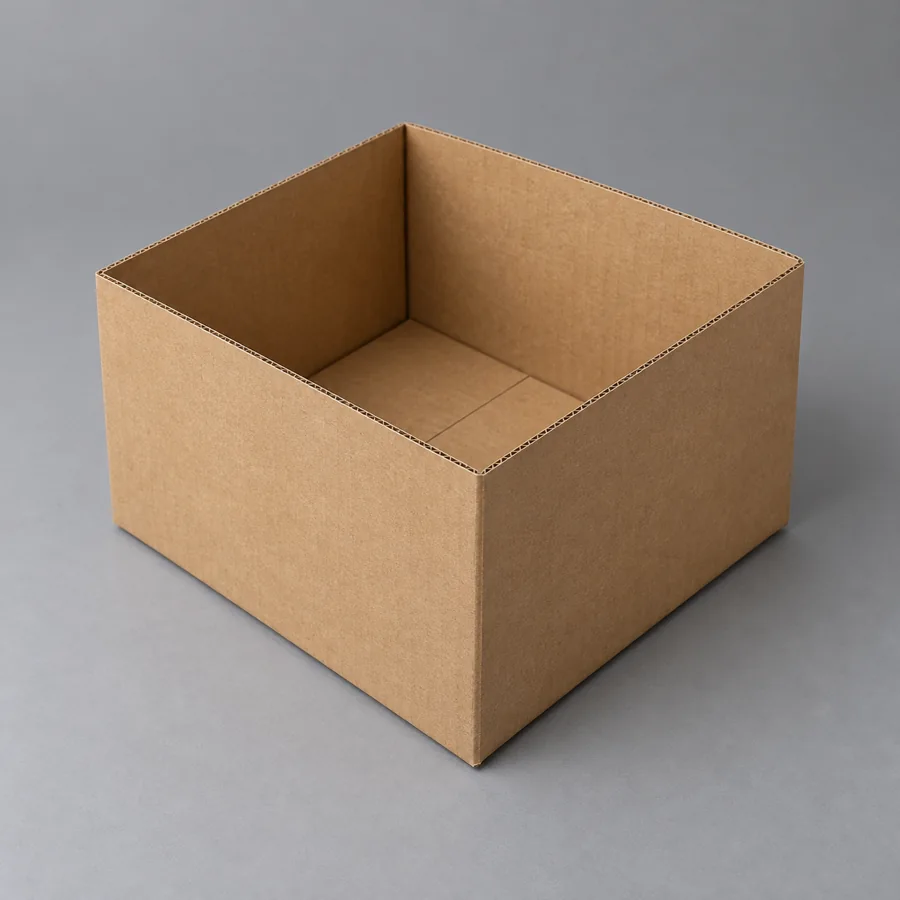
Realistic reference of a half slotted carton with an open top, no top flaps and a closed base

HSC

Half slotted carton

Bottom flaps close the base; the top stays open. A separate lid can be specified.

Common use
Top loading or packing with a separate cover.

Look for: an open top without flaps.

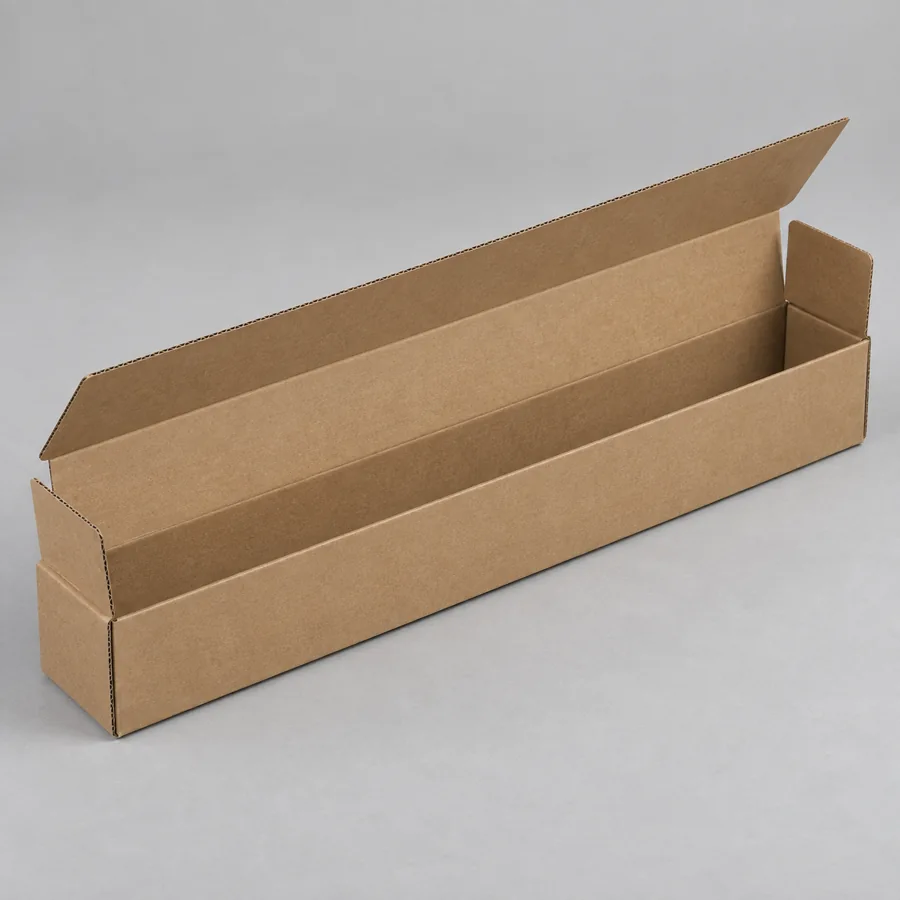
Realistic reference of a long five-panel folder partly open to show its wrap-around construction

5PF

Five-panel folder

A scored sheet wraps around the product, with an overlapping panel for closure.

Common use
Long or narrow items that are easier to wrap.

Look for: the wrap-around panel.

Generated visual references for style identification. Final proportions, flaps and closure follow your approved carton drawing.

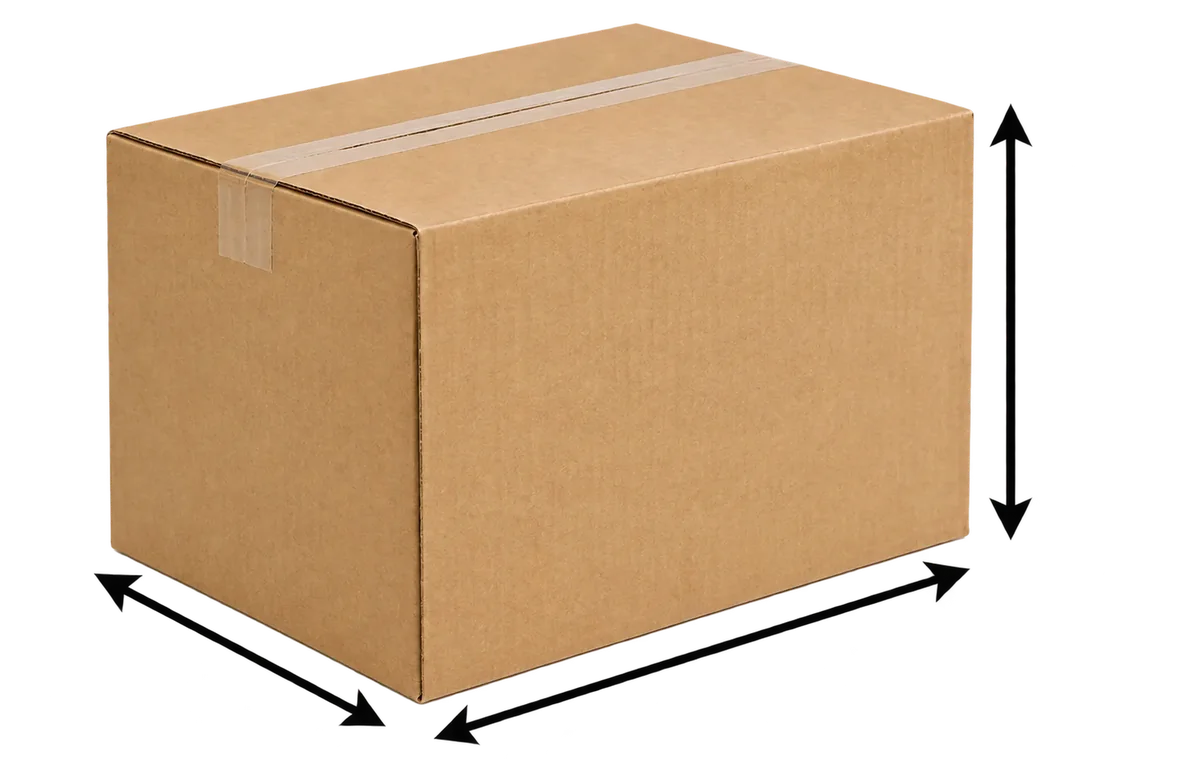
Outside sizeL × W × H
Newbox carton with outside length, width and height measurement arrows
Measure the finished outer edgesReading in millimetres(mm)

06 / Measuring your carton

Measure the outside: L × W × H.

Measure the finished box from one outermost edge to the opposite outermost edge. Record every dimension in millimetres and send them in Newbox order: L × W × H.

  1. L - LengthMeasure the longer outside side of the opening
  2. W - WidthMeasure the shorter outside side of the opening
  3. H - HeightMeasure from the outside base to the top with flaps closed

Outside-size example: 400 × 300 × 250 mm means Length 400 mm, Width 300 mm and Height 250 mm.

Inside or outside?

Newbox’s enquiry form asks for outside dimensions. For product fit, share the product dimensions and cushioning space, or clearly label the internal size needed. Measure the assembled box with flaps closed: length is the longer side of the opening, width the shorter side, and height is base to top. Do not include open flaps.

07 / Strength & stacking

Board strength. Box strength.

Two useful tests answer different questions. Ask for the result, units and test conditions when comparing specifications.

ECT / BOARD SAMPLE

Edge crush test

Measures a board sample’s resistance to compression on its edge. Usually reported in kN/m or lb/in.

Useful for comparing board performance, but it does not by itself establish a finished carton’s load limit.

BCT / FINISHED CARTON

Box compression test

Measures the assembled carton’s resistance to compression under defined conditions. Commonly reported in N or kN.

Helps assess stacking performance. Confirm the box design, conditioning and test setup with the result.

Not a weight allowance

A BCT result is not the weight you can safely put inside a carton or leave stacked on it indefinitely. Storage duration, humidity, pallet support, stacking arrangement and handling affect real performance.

Before requesting a quote

Send six useful details.

These details allow our team to recommend a board instead of guessing from one term such as “double wall.”

  1. Product weight

    Weight per item and the total packed weight.

  2. Outside box size

    Length × Width × Height in millimetres.

  3. Stacking requirement

    How high and how long cartons will be stored.

  4. Delivery conditions

    Local delivery, courier, palletised transport or export.

  5. Handling environment

    Moisture, cold room, manual handling or rough movement.

  6. Quantity and printing

    Estimated order volume plus print or branding needs.

Plan your order

Samples, timing
& common questions.

Samples & delivery

Can I get a free carton sample?

Yes, samples are free. Delivery charges apply for sample deliveries outside Melaka. Share your product details and the carton specification you would like to try with our team.

What is the production and delivery time?

Production usually takes 3–7 business days. Delivery transit time is separate and depends on your location. Contact our team to confirm the production schedule and delivery arrangement for your order.

Board & carton questions

What does K150/M120/T150 mean?

Using the notation in this guide, K150 is kraft liner at 150 grams per square metre, M120 is corrugating medium at 120 gsm, and T150 is test liner at 150 gsm. If listed outside to inside, these describe the three papers in a single-wall board. Confirm the layer order and flute with your supplier: these codes are not a universal strength rating.

B flute vs A flute: which should I choose?

B flute has a more compact profile, about 3 mm in the Newbox reference, and provides a relatively smooth surface for printing. A flute is about 5 mm and offers more cushioning. Choose the complete board for the product and delivery conditions; flute letters alone do not guarantee stacking strength.

150 gsm vs 175 gsm carton: what is the difference?

GSM means grams per square metre of paper. A 175 gsm paper is heavier per unit area than 150 gsm paper, but it does not automatically make the carton stronger. Ask which layer the number describes, and compare paper grade, flute, full board construction and relevant test results.

Kraft vs test liner: what matters?

Kraft liner is made mainly from virgin kraft fibre; test liner mainly uses recovered fibre. Both can be used in shipping cartons. Compare the specified paper performance and complete board construction. Brown colour alone does not identify the fibre content, and neither standard liner is waterproof.

RSC vs 5PF vs HSC: what is the difference?

RSC means regular slotted carton, with top and bottom flaps that close the carton. HSC means half slotted carton, with one open end and flaps at the other; a separate lid can be specified. 5PF means five-panel folder, which wraps around the product and can suit long or narrow items. Confirm the drawing, closure and any separate lid.

How do I measure carton size?

For the Newbox enquiry form, give outside length x width x height in millimetres, measured on the assembled carton with flaps closed. Length is the longer side of the opening, width the shorter, and height runs from base to top. If you only know the product size or internal space needed, label it clearly and allow for cushioning. Internal and external dimensions are not interchangeable.

What is BCT / compression strength?

The box compression test (BCT) measures how a finished carton resists compression under stated test conditions, commonly reported in N or kN. It helps assess stacking performance. A laboratory result is not a safe packed-weight or long-term stacking limit: humidity, storage time, pallet support and handling also matter.

Is ECT the same as BCT?

No. The edge crush test (ECT) measures the edgewise compression resistance of a board sample, usually in kN/m or lb/in. BCT tests the assembled carton. ECT is useful when specifying board, but carton dimensions, joints, openings and construction also affect finished-box performance.

Is double wall always better than single wall?

No. A correctly specified single-wall carton can suit many products. Double wall adds layers and thickness for more demanding protection or stacking requirements, but the full paper combination and finished design still need to suit the pack.

How many kilograms can this carton hold?

There is no reliable weight limit from GSM or flute alone. Share the total packed weight, dimensions, product support, stacking height and duration, plus the delivery route. A suitable specification and, where needed, packed-product testing are the basis for a recommendation.

Will a thicker carton protect fragile products on its own?

Not necessarily. Fragile products may need dividers, corner protection or cushioning to stop movement and keep them away from the carton walls. Assess the complete packed product for the handling and transport it will face.

Can corrugated cartons be used in humid or cold storage?

Moisture can reduce paperboard performance. Explain any humidity, condensation, cold-room or wet handling exposure before selecting the board. Suitable papers, treatments and testing may be needed; ordinary corrugated board is not waterproof.

Can I match an existing carton without its board specification?

A sample helps identify its style, dimensions and construction. Send any printed board code and explain how the pack is used. Appearance alone cannot confirm the original paper grade or strength; ask for the proposed replacement specification and validate it for your product.

Need a board recommendation?

Send the product details. We will help specify the carton.

WhatsApp us